
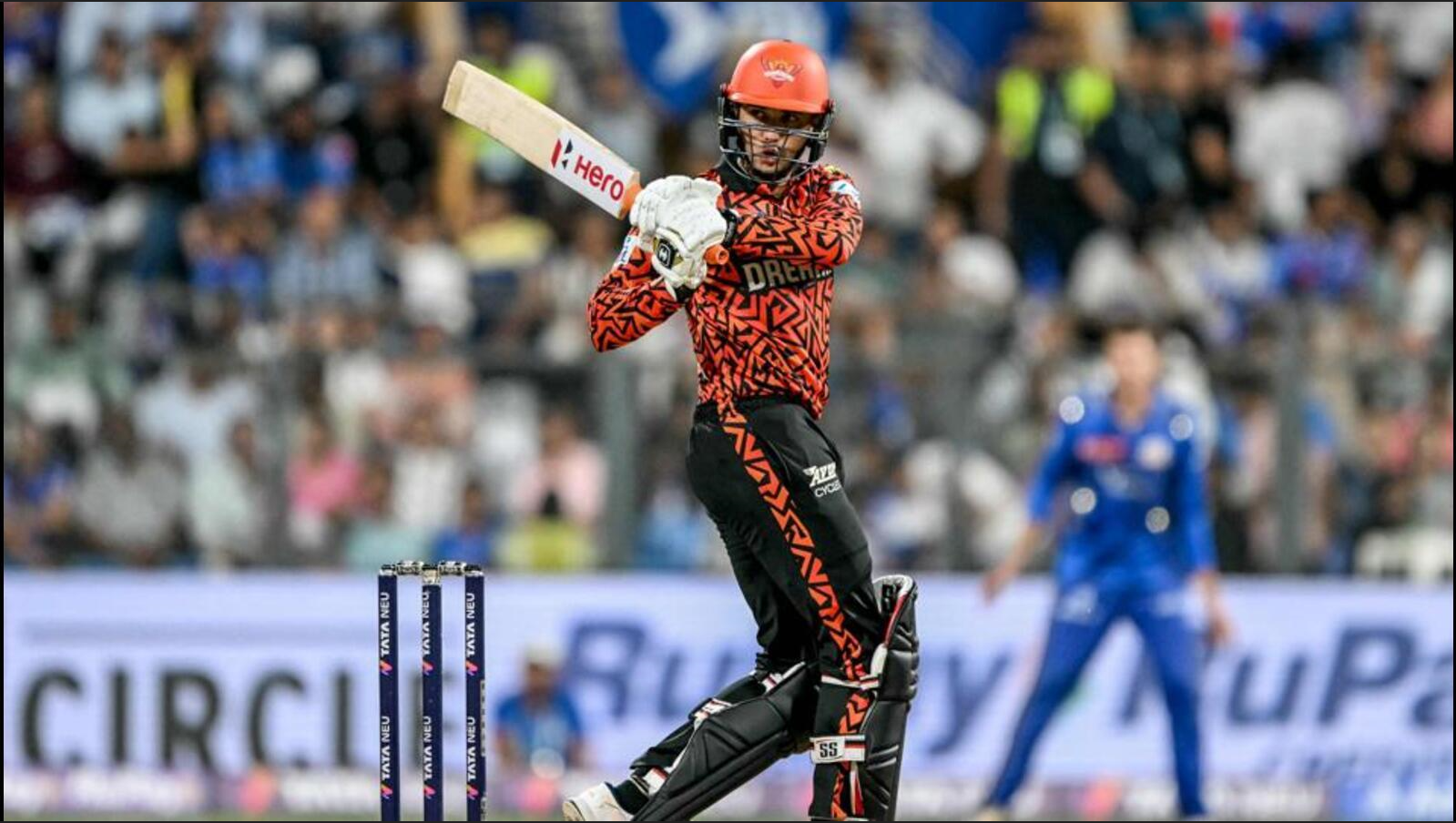
Abishek Sharma it sat up outside the Chinnaswamy but Abhishek Sharma threw his hands up to the first ball. No sigher. Not a cheque. A full blooded carve over cover told him this season was going to be fast, a little reckless and often on his terms. The field was spread by the time the bowler had finished his second over. You could see the danger too.
First Game of Abhishek Sharma
Bengaluru had a modest start on paper (14 off 9) but the ploy was vital. He dragged length back and went to seamers and got the captain to pull mid-off wider than he wanted. Abhishek is collecting this silent tax. Even when he doesn’t get it, he alters the location of the next batter’s hit. Then came a longer, cleaner stretch of 42 in Hyderabad.
He trusted that whip over midwicket to the short side more than he should have, and he trusted it again. You could count three edges short or wide and strokes that didn’t quite make it. But the pressure was on him rather than the bowler.
And then came the dip. 7 off a left-arm fast who held the length just behind a drive and turned it across. Abhishek nicked once and flirted twice. Not present. And the pattern came in patches all through the season. Sometimes he would reach for the first boundary when bowlers refused him it, and the innings was over before it had begun. It is easy to call it impatience. And it is a calculated gamble that he will get two overs of control with the first boundary.
Game four Of Abishek Sharma
He got into a rhythm. 63 of 31. Game four, when the opponent tried to bounce him. He got on it. He didn’t hook with force, he rolled the wrists and kept it down, punishing anything that fell just a little bit short. The temperature changed in that innings.
The keeper chirped as the field entered and you could see the bowler was thinking about him even between deliveries to the non-striker. That’s leverage. This is life of Abhishek.
The next zero came almost on schedule. ball one. A simple catch, a push without feet, a length ball that held its line. There’s no way to put a nice face on that. They agreed to this trade off when SRH sent him out with a license rather than a script. Nor did they move him down the order because they accepted it. They redoubled their efforts.
And then in game six, the first big statement of the season was made: 88 for 44. Not a great inning. It was a mis-hit that flew a yard past mid-on. It had swings and a smooth travelling top edge. But there was a purpose in each over.
When the field chased him, he attacked the sixth-stump channel with that high-elbow slap through further cover and then turned to the leg side. He got 16 off the spin on the powerplay and made the captain burn.
attacked the sixth-stump
It might be seen as inconsistent. It could be read as an honest part, too. He slowed down a little in the 55 (eight balls for six runs) but when the field crept, he detonated. It was necessary to stop. It showed that he could recalibrate without losing his edge, but he did it rarely. The same old dismissal – a push at width without the feet, the ball taking the outside edge – appeared in the 12 and the second zero. To defeat him bowlers needed discipline not mystery.
But it is hard for athletes like him to adhere to templates. The next 33 came at what seemed a healthy strike rate, but the dismissal came just when the game needed 10 more balls. It’s the unspoken criticism all season long. Sometimes he wins full-on powerplays, but he doesn’t always get the job done at hand. And also in T20, finishing is more important than starting. You know it, and he knows it, and the dressing-room knows it.
67 settled on a gripping surface
The 67 settled on a gripping surface. He fought it instead of riding it. He used the tempo, stayed on the ground longer than normal, opened the face late. It was going at a pace, but by his standards, it looked almost conservative. That innings spelled out the word ‘adaptability’, not always a word that goes with his moniker. But it fit there.
Then he tried to impose a length that never materialized and ended up with a forgettable, short 5. Then came the 82, possibly his most complete knock of the season. He was cautious early, hitting eight of the first nine, but reconsidered as the field opened.
He hit straight, square, straight again. He did not run to the ball but made the bowler come to him. The athlete seemed to be choosing his moments rather than reacting to them. It was like control. For a minute.
The story of technology is simple. Sometimes he yields his hands before his feet, likes width early and uses his bottom hand to clear the infield. bowlers who keep a tight channel just outside off, right behind a drive, drag him into low-percentage shots.
Bowlers are compensated
Bowlers are compensated for even a small mistake. There is no middle ground, captains either vehemently oppose him, or are stubborn conservatives. The middleman is punished.
The behaviour of SRH in his vicinity should be noted. After the setbacks, they didn’t lock him away. They didn’t “shelve” him by demoting him. They let the rest of the order take the variance, while keeping him in the place where it hurts the most.
“That’s a team thing, and a player thing. They value the 20-ball 40 as much as the 60-off 40, maybe even more in some cases. It also says they regard the first-over wicket as a cost, rather than a disaster.