
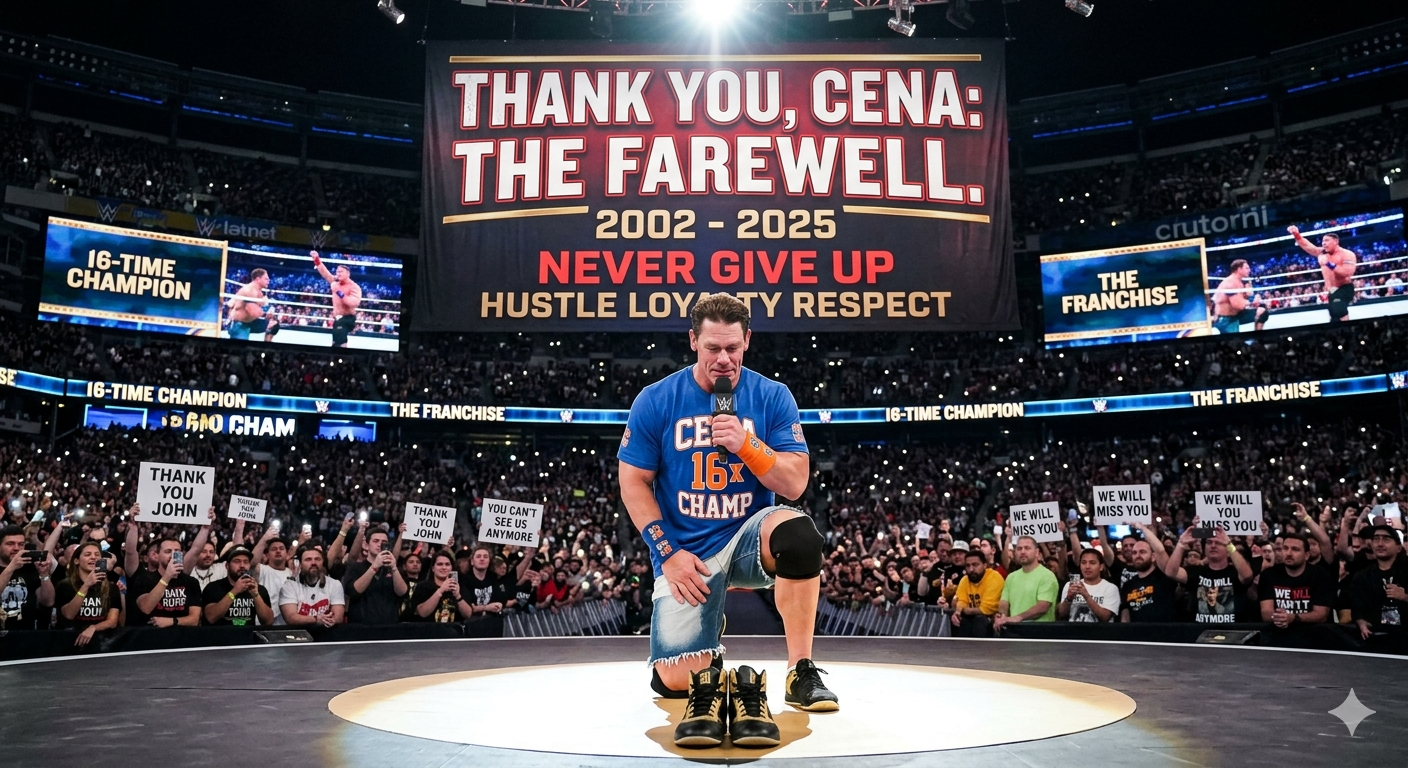
John Cena’s WWE RETIREMENT KEPT charging the ropes
The man in the ring has fewer dates left does not make the bell ring softly. You could see it in the way John Cena’s WWE RETIREMENT KEPT charging the ropes, hitting them as if they owed him something, waiting for the half-second pause in the crowd before a chant started. The body knows. The calendar knows this. But that doesn’t slow down the performance.
That accessibility created something more profound than fame. It established a pattern.
You learned ring psychology after you knew his timing. spin-out slam, shoulder block, shoulder block. Then came the hand waving. Then there was the Five Knuckle Shuffle. Before the verse started the sequence looked like a chorus you knew. The critics thought it was boring. They did not grasp the idea. The memory is made by repetition. Attachment is reinforced by memory. In this sense, a child in Chittagong or Lahore might correctly forecast a game but watch it the next week.
But nostalgia hasn’t been the only ingredient in this latter phase. That would have been easy. Instead, Cena fought less fights, yes, but he’s fought each one like it’s more important than the result. The tempo changed. His breathing grew longer in between his movements. Not slower. Just more considerate. Now you can feel that he picks moments.
John Cena’s WWE RETIREMENT:
Look at his stats over the last several years of work. They only appeared a handful of times – often less than ten games a year – but whenever they did, they generated an outsized level of interest, ticket sales and streaming surges. He didn’t require a title run to be relevant. That’s unusual. Most careers go downhill when the belt is lost. He did not do that. Because the audience has long ago stopped judging him by his wins and losses.
And it’s in South Asia that this change is most significant. You’ll see the fans don’t always stick to weekly continuity here. Broadcast schedules are behind. Odd hours are when pay-per-view shows are on. You take what you can get. So the stars that survive the plot holes are the stars that survive. Cena did it, You could jump into any game mid build and within seconds understand his role.
retirement talk poses a harder question
But even with a less sensationalized word, this retirement talk poses a harder question. What is Cena leaving behind when he exits?
not just a performer. a reference point.
For every generation of South Asian fans, one important figure dominates their wrestling memories. Some thought it was a grainy feed of Hulk Hogan flexing. Others interpreted it as The Undertaker walking that slow, unobtainable walk. For the past 15 years, it has been Cena. He was disqualified.
You don’t know it, but you measure every new face against him. Work ethic. Clearance sale. crowd control. “He has set a bar and therefore you have some expectations. The thing is, standards don’t retire gracefully. They remain. They stalk the next person.
But eras are not defined by weekly shows. It’s the cultural memory.
And Cena’s memory is very much a part of this place. Deep enough that even those who have drifted away can still recognize the song after two beats. Then the intro in brass comes on and the temperature drops in the room. You sit down. You check the screen to make sure it’s not just a highlight reel.
“It’s real-time.
It is not a reaction to an accident. It is from the years that he led the company through changes that could have split the audience. uncertainty in the post-attitude epoch. the transition to a product more suited to families. the introduction of narrative into international markets without linguistic complexity. Cena was not only able to survive those shifts. He buffed them.
Yet he was always dogged by criticism. Way too predictable. Too secure. Too central. A few of the points are good. He was a huge winner. He was in the spotlight longer than the others. Often the booking curved around him.
But you don’t hear this argument enough: constancy is costly. When you anchor a product for more than 10 years you take on its ups and downs. You’re stuck with lame storylines. “You go through your matches with experimental gimmicks. You’re not stuck choosing the best content. You have the usual weeks too. That was Cena. Week in. Year out.
Nothing positive. Just a constant change
From his later full time years, with a 21-minute loss in the main event due to interference, a 17-minute title defense, a clean win, a 12-minute tag match, a protected finish and then finally a pay-per-view loss to push the next star, the tale is told better in the outcome than any speech. Nothing positive. Just a constant change. Well, you’re the center. That’s your job.
South Asian fans watched it all in bits and pieces. Not all programs. Not every promotion. ” Enough to piece the pattern together. Enough to know that here it wasn’t just a matter of winning. It was about keeping your shape as the world around you was changing.
The retirement phase contributes to this understanding
The retirement phase contributes to this understanding. Because every appearance looks limited now. You think this is maybe the last time he hits that sequence in the middle of the game, but you don’t say it out loud. The last time, the crowd was chanting in perfect unison. That near-fall, that last time the half-smile was caught by a camera.
It changes the way you watch. You concentrate on the small stuff. footwork timing how he uses non-verbal communication to engage the audience. There were always those details. In plain English, you had no reason to separate them sooner.