
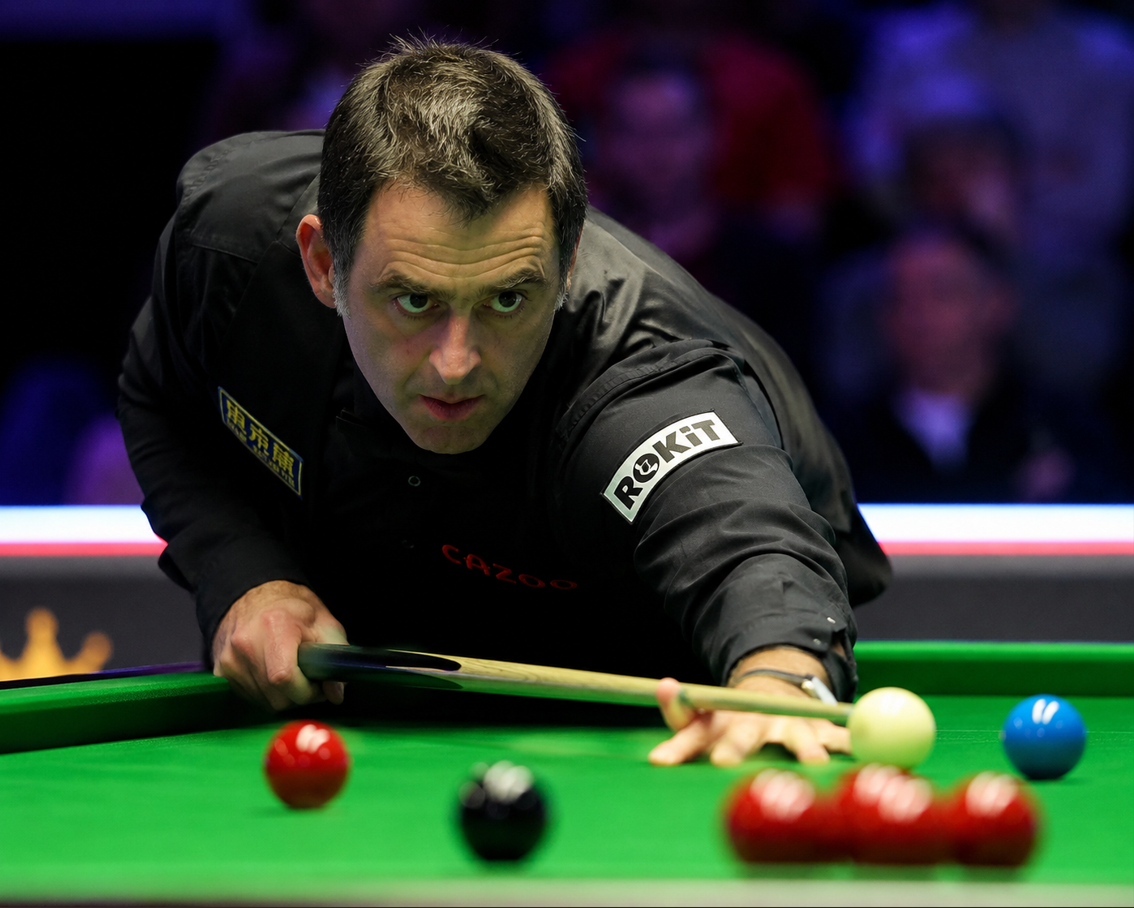
O’Sullivan replies immediately. A 105 clearing that looks sloppy at first, a red that most players avoid during this part of the game. He rises a little early after the last black, as if the decision had been taken somewhere in the middle of the break. When he plays like that, it doesn’t matter if it’s 1-1 in frames. There is no tightening of the table round him. It opens up.
The match then turns again.
John Higgins vs Ronnie O’Sullivan Higgins has just made one slip of safety, and Ronnie intervenes, and suddenly the table makes sense. Red clusters disappear. Colors come like they’ve already lost the debate. This time Higgins has a break of 92, but it’s not even his cleanest work and he goes back to his chair more slowly than before. Not quite shook. calculations . rebuilding .
The score board reads 3-2 at one point but that is a lie. How many times the frame resets itself within one visit is never revealed. Higgins takes a frame with accurate positional play, no waste and no exaggerated cue action with a clearance of 105 of his own. Just economics.
Control versus release. Higgins looks at each beam and creates structures that resemble match sticks. O’Sullivan’s plays are demolition that accidentally becomes construction.
Safety exchange
Next there’s a long safety exchange of almost five minutes of thin contact play where both reject slightly incorrect angles. The white keeps going into the middle of the table, near the baulk cushions, and back again.
The audience starts reacting to sequences instead of to individual shots. Higgins misses one escape and Ronnie gets the chance he needs. He’s taking it easy.” He never really rushes when it comes to important stuff. He’s already out of his chair after a break of 78 ends the frame before the final ball falls.
Higgins, however, does not go out of the game. He never has. He starts the next frame with three reds, two long pots that just scrape the jaw and one safety that so tightly pins the cue ball behind the green that you might miss it if you blink. Ronnie replies with a 73 and then misses a red down the middle that looks out of character and almost human in the timing. And the table breathes again.
Topping The Table
Depending on who is sitting at the table you can sense the crowd leaning a different way. Not too loudly. Snooker fans here don’t really explode. There’s a shared tension whenever Ronnie lines up long pots and a quieter patience when Higgins circles the table as though solving a problem rather than playing it.
Sometimes a simple safety exchange can become complicated. each, two visits, then three. Higgins has a little cut down the rail from Ronnie’s errant cue ball. He leaves it in the pot for longer than usual. But he’s recalculating the next three shots (which may never happen), not the frame. He shoots 64 but leaves a red a tad awkward. That little flaw costs him the frame.
Ronnie clears again. not in control. Accurate when it matters.
To think that this rivalry is for artistry over discipline is too simple. He plays attacking snooker when he has to. Ronnie is a better safety player than most people give him credit for. Differences are in the response time Ronnie is quicker to seize opportunities. Higgins is quicker on the uptake. That division defies everything.
in-off attempt
One in-off attempt from far away, swung in on a late frame. Higgins plucks a tight safety, gives a half chance, and nicks the red a little too thick. When Ronnie intervenes and clears 88, the table looks smaller, as if space had contracted to fit him in. He does not rejoice. He rarely does that in these games. A look at the score, a slight lift of the cue, already looking to two frames ahead.
Higgins sat down again, his chalking pace modified but his expression the same. a little faster a touch less patient. These are things you only know once you’ve watched him long enough. He changes all the time but Ronnie makes the changes faster than most players let him.
Ronnie With a Break
And like so many previous meetings, the last part of this one will not be resolved. Frames are sent one way and then the other. Higgins’ 70 break looked a return to control. Ronnie had a 94 which looks like the return of inevitability. Neither player walks away with a thing. Even if one is ahead, the other is close enough to make every mistake expensive.
Late in the game
Late in the game there’s a period where both players miss simple reds on successive visits. Not exactly exhaustion. The contest has, so to speak, squeezed their margins. The pressure builds to a point that no one in the room can calculate, the table grows less generous and the pockets seem to narrow.
Eventually, although not without difficulty, Ronnie is back on the up. Higgins gives him one chance, then another. O’Sullivan’s last frame is a tight affair until he pots a mid-range effort which looks more down to timing being on his side than good execution. He clears the table in 2 visits. There is no last flourish. Just finished.